
Track contractions accurately
Automatically measure the average contraction length, interval, and number of contractions per hour.
Your reliable companion during labor. The easiest way to time your contractions, stay calm, and know exactly when it's time to go to the hospital.

Labor contractions can be confusing, especially in the early stage. Our contraction timer analyzes the duration, frequency, and pattern of contractions to help you understand what stage of labor you are in and when it’s time to go to the hospital.

Automatically measure the average contraction length, interval, and number of contractions per hour.
See how your contraction pattern changes as labor progresses.
Clear contraction patterns help you decide when it’s time to leave.
Understanding the rhythm of a contraction helps you work with your body rather than against it.
The building phase where the muscle fibers of the uterus tighten and intensify.
The peak intensity of the contraction. This is the shortest but most powerful part.
The fading phase where the uterus relaxes, allowing for rest before the next wave.
Learn the patterns and phases of labor to stay informed and calm.
It can be hard to tell the difference. Braxton Hicks (false labor) are typically irregular, don't get closer together over time, and often stop with movement or hydration.
True labor contractions follow a predictable pattern. They get longer, stronger, and closer together (frequency increases). As shown in the diagrams, real labor involves a distinct increment, acme (peak), and decrement phase that builds intensity consistently.
When to head to the hospital
According to standard obstetric guidelines and healthcare providers worldwide, the 5-1-1 rule is a reliable indicator that you are in active labor and should head to the hospital.
Your contractions are coming every 5 minutes.
Each contraction lasts for at least 1 minute.
This pattern has been happening for 1 full hour.
Enter your current contraction data to see if it's time.
This is an educational tool, not medical advice. Always consult your healthcare provider.
Always consult your healthcare provider for final advice.

Tap Start the exact moment you feel the contraction tightening begin.

Breathe through it. Wait until the sensation completely subsides and tap Stop.

Relax while we automatically calculate the Interval between your contractions.
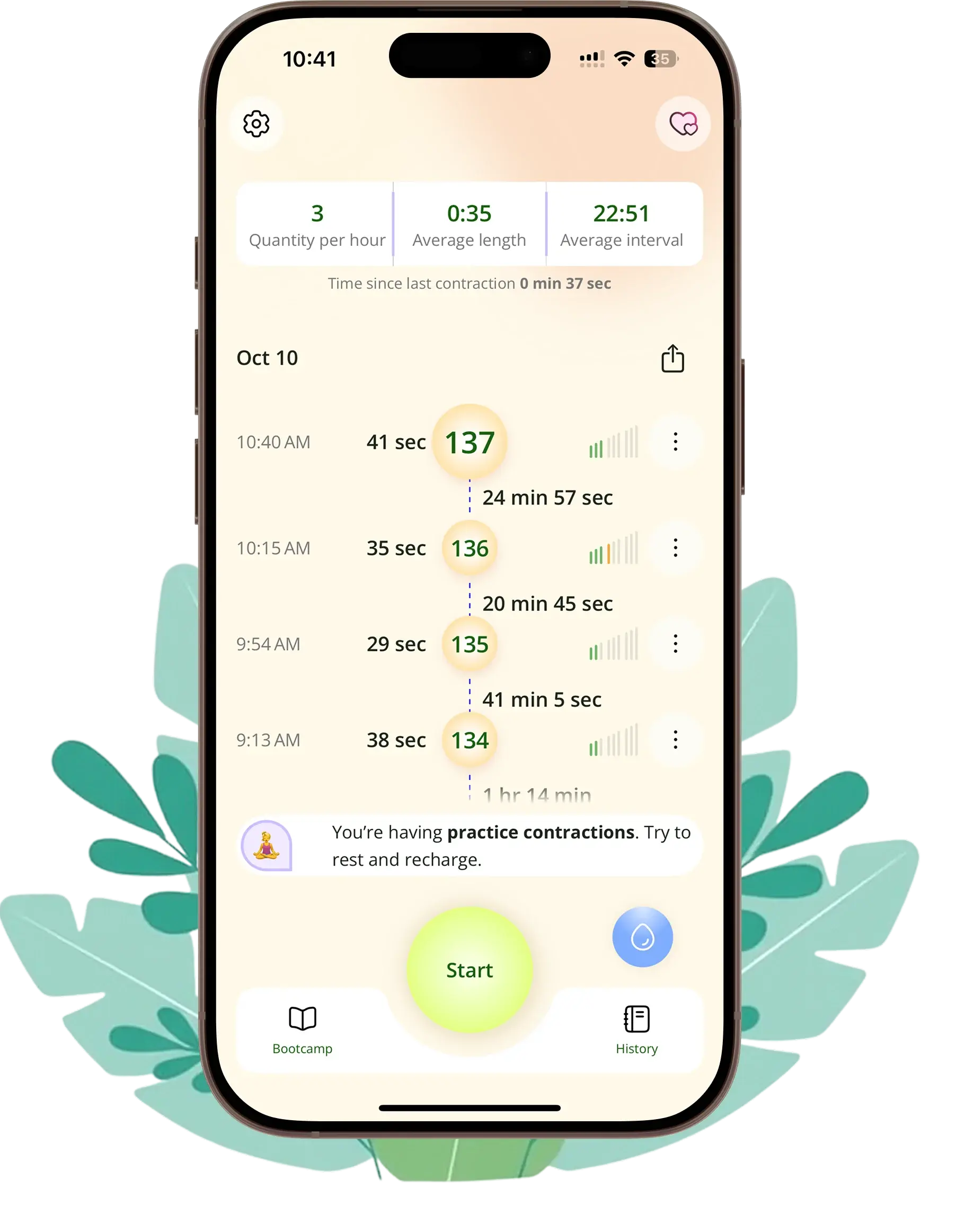
Record exactly when the tension begins. Keep a log or use our built-in tracker for accuracy.
Note when the contraction fully subsides. This marks the end of one peak cycle.
Calculate the length of the contraction. Active labor typically aims for 45-60s.
Measure the time from the start of one contraction to the start of the next.
Follow the 5-1-1 rule. If your data matches this pattern, head to the hospital immediately.
What to expect as you transition through labor
0-6 cm Dilation. This stage can last hours or days. Stay home, rest, and stay hydrated.
6-8 cm Dilation. Contractions are stronger and more frequent. Time to head to the hospital.
8-10 cm Dilation. The most intense phase but the shortest. You are almost there!
During active labor, grabbing your phone might be the last thing on your mind. Our Apple Watch companion app lets you record contractions with a single tap, right from your wrist.
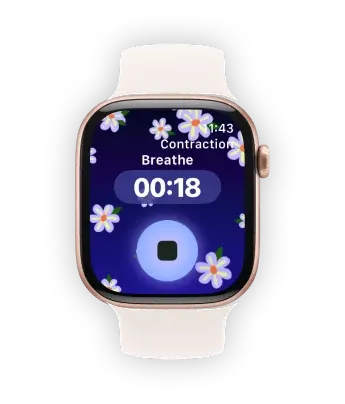
Your data stays on your device. No account required.
Designed for use during real contractions — large buttons, dark mode.
One-tap timing with automatic frequency and duration calculations.
Know exactly when it's time to head to the hospital.
Short practical answers about timing contractions and knowing when to go to the hospital.
Start timing when you feel regular, recurring abdominal tightenings or cramps. It is especially important to time them when they become noticeably stronger, longer, and closer together.
The 5-1-1 rule is a common guideline indicating it is time to head to the hospital or call your provider.
It means your contractions are at least 5 minutes apart, each lasts for at least 1 minute, and this pattern has been consistent for at least 1 hour.
Braxton Hicks are usually irregular, do not increase in intensity, and often subside with rest or hydration.
Real contractions are regular, grow stronger and closer together over time, and do not stop when you change positions or rest.
Duration is timed from the very beginning of one contraction to the end of that same contraction.
Frequency is timed from the start of one contraction to the start of the next contraction. Our app calculates both automatically so you do not have to do the math.
You do not need to track every single one. If they are mild and irregular, you can just rest and stay hydrated.
Start tracking continuously when they become uncomfortable, regular, and you want to see if a pattern like 5-1-1 is emerging.



“This app made tracking so much easier! It practically told us when to head to the hospital. A must-have.”
“Clear, simple, and exactly what we needed during labor. The 5-1-1 alert gave us peace of mind.”
“Love the dark mode for middle-of-the-night tracking. It is so intuitive, even through the pain.”
Download Contraction Timer now and be fully prepared when the time comes.